
From Page to Phone: Why Vertical Dramas Could Become the Next Serious Distribution Channel for Authors
Most authors won’t be offered a traditional publishing deal. The determined ones will go on to self-publish. The industrious ones will take it even further. Options abound. These include audiobooks, the German or Portuguese translation, a film, a children’s book version, a podcast, a newsletter, an episodic release, or a Substack serial.
Well, I just discovered another option that is becoming impossible to ignore: the vertical drama.
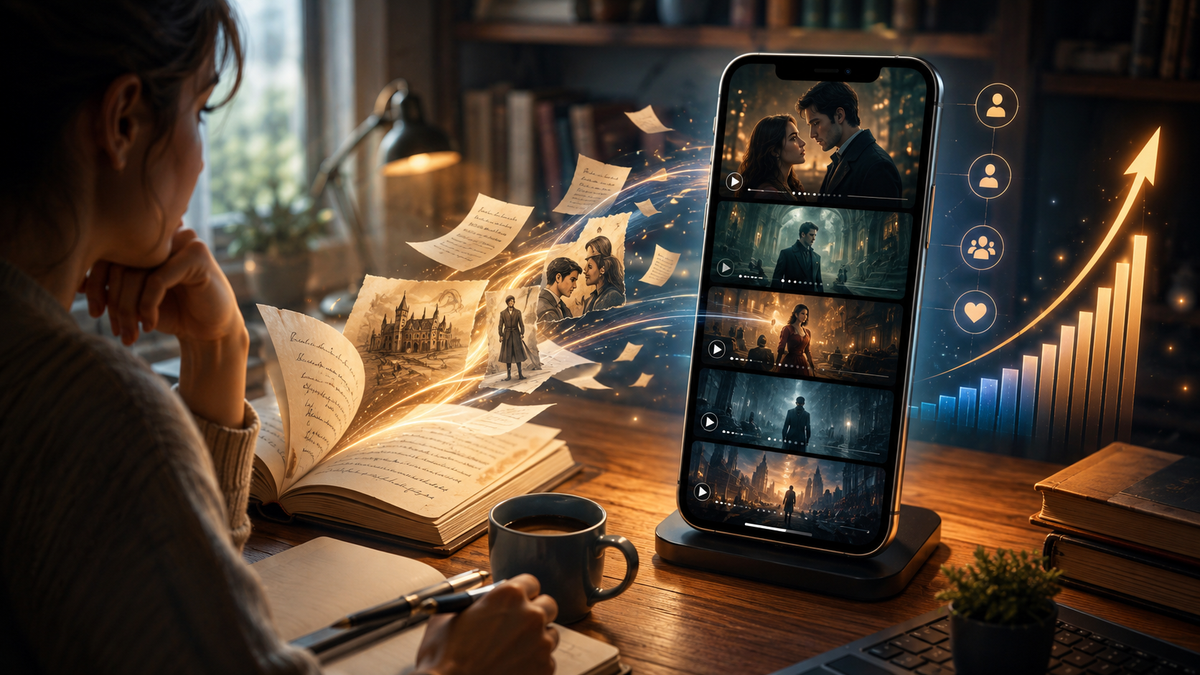
Vertical dramas, also called microdramas or short dramas, are scripted stories made for phones. Episodes usually run between 60 and 90 seconds. They are intended for mobile phone consumption (shot vertically – hence the name), centered around emotional engagement, and structured to push the viewer from one cliffhanger to the next. The plots are often shamelessly melodramatic: secret billionaires, revenge marriages, werewolves, hidden heirs, Mafia lovers, betrayed wives, contract relationships, and dramatic identity reveals. They are designed to be addictive. That is precisely why authors should pay attention, and why I have been obsessed with the concept for a few weeks now.
So read till the end and watch my teaser!
No longer a novelty
The microdrama boom began in China and East Asia, but it is no longer a regional curiosity. In China, the format has moved from cheap mobile entertainment to a major entertainment economy. The Chinese microdrama market reached $7 billion, in 2024, significantly outpacing the country’s annual film box office for the first time. By 2025, the picture was even more striking with microdrama revenue at almost $10 billion in 2025, and more than 830 million viewers. Outside China, the format is now expanding quickly across the United States, the United Kingdom, Southeast Asia and other markets. Microdrama apps generated $3 billion globally outside China in 2025, with the U.S. alone accounting for $1.3 billion.
It’s not yet Netflix, or Hollywood. But it’s not a home movie either. Microdramas are cheap enough to make quickly, and professional enough to monetize.
How much can a successful vertical drama make?
While a standard vertical drama series often costs between $80,000 to $250,000 to produce, the app My Drama said its hit series generate $12 million to $15 million in revenue with super successful microdramas earning up to $35 million in North America.
That revenue is obviously divided up between the author, production team and the distribution platform. There are several ways the author can structure this.
The weakest model is work-for-hire. In that case, the writer is paid a fee to script or adapt the story and may have no ownership in the finished show. This is good for a paycheck, but it has a very rigid cap with no upside.
The next model is a flat option or license fee. A platform or producer pays the author for the right to adapt the book. This can be attractive if the author retains book rights, sequel rights, audio rights, translation rights and future approval rights. But if the fee is low and the rights grant is broad, the author may have sold the most valuable part of the property too cheaply.
The most interesting model is a license plus performance participation. If an author negotiated even 1% to 3% of gross revenue on a genuine hit, the numbers become very meaningful.
The most lucrative model is ownership: the author, publisher or rights holder produces or co-produces the microdrama and participates as an owner rather than a passive licensor. That is where the upside can become serious. But that model also carries the greatest risk, because production is only part of the cost. Marketing, user acquisition, platform fees, and editing can also be very pricey.
Compare that to a successful author
When comparing this to a standard book distribution deal, the delta is revealing.
According to the Authors Guild’s 2023 author income survey, the median income for full-time authors from books plus book related activities such as teaching, speaking, editing and related work, was $20,000. Full-time commercial-market authors did somewhat better, with median book plus related income of $25,000.
That means a single strong microdrama licensing or participation deal could equal several years of income for many working authors. If an author earns roughly $3 per ebook sale, they need tens of thousands of sales to equal the licensing revenue on a single successful series. And the two distribution formats are not mutually exclusive.
Why books are well suited to microdrama adaptation
Not every book should become a microdrama and not that all microdramas will be successful. Literary fictions, intricate plot structures and voice dependent storytelling will struggle to be impactful in the microdrama medium. But many commercial books are already structurally close.
Speculative fiction in the romance, romantasy, thrillers, domestic suspense, time-travel, YA, paranormal, revenge fiction, and crime genres often contain exactly what vertical drama needs; that being conflict, secrets, reversals, and emotional stakes. Simple but forceful works best: “She married him without knowing he was the billionaire who ruined her family”; “The rejected mate returns as queen”; “The maid is secretly the lost heiress”; “The woman he betrayed now owns his company.”
These novels are best positioned to transition into vertical drama for three reasons:
- the full plot has already been worked out.
- they provide a tested emotional premise.
- the characters have been fleshed out already and can be extended into sequels, spin-offs or alternate versions. That is important because the real value of microdrama is not one show. Like series books, the viewers will want more. For authors, this means the adaptation process should not simply be “turn the book into video.” It should be “turn the book into an episode engine.”
Adaption challenges also exist. A novel chapter may have three or four scenes. A vertical drama needs a hook every minute. The author must think like a dramatist and a marketer at the same time.
The danger: selling the crown jewels too cheaply
Authors should be excited by microdrama, but not naïve.
The vertical drama industry has grown quickly because it is fast, cheap and hungry for story material. That creates opportunity, but it also creates rights risk. If platforms want proven story premises, authors should treat those premises as valuable intellectual property and not just cookie-cutter content. It might seem tempting to enter into any kind of agreement that is offering distribution and some kind of paycheck, given the novelty and newness of the medium. It will look very different if the show generates millions. Authors should push for clear limits and seek help and advice whenever anything looks like over-reach or unnecessarily complex. The author should always retain a path to the upside if their story works.
Getting started
An author who wants to explore microdrama should not start by filming a whole series. The better first step is to create the offering. That means creating a microdrama adaptation package from the manuscript: a one-page hook, a season synopsis, character descriptions, 60 to 100 episode beats, sample scripts for the first five episodes, and a rights summary showing exactly what is available. The first ten episodes matter most because many apps use free early episodes as the conversion funnel. Those early episodes must establish desire, humiliation, betrayal, danger, attraction or mystery almost immediately.
Authors should also identify which part of their book is most adaptable. Sometimes the novel won’t work in its entirety. The microdrama element might revolve around one relationship, one revenge arc, or one secret identity.
Self-production is possible, but difficult. A microdrama may cost far less than a traditional series, but it is still professional production that can run into $100,000. The author would need casting, locations, sound, lighting, editing, subtitles, platform strategy, paid acquisition and retention analytics. For most authors, the more realistic route is a partnership that involves licensing the series to a platform, finding an executive producer, or working through a publisher or agency familiar with this distribution channel.
The conclusion for authors
Vertical dramas are not a magic path to riches. Most will not become hits. Some will be badly made. Some platforms will offer poor terms. Some stories will be flattened into clichés. And as the market matures, regulation, competition, advertising costs and audience fatigue will all dim the lights.
But the format is now too large to ignore.
The big lesson is that story consumption is fragmenting. A book is no longer only a book. It is a world that can be reshaped and shared with multiple consumers across many thriving platforms and channels.
Successful authors have already used episodic platforms like Wattpad and Inkitt to prove audience demand, build fandoms and move into books, film, TV and app-based storytelling. Microdramas are the next step in that same evolution. It takes serialized fiction, compresses it into phone-native video, and monetizes the reader’s old desire in a new way: “What happens next?”
For authors, that question has always been the business. Now it may also be the distribution channel.
So, without further ado, I present my entry into the microdrama market. Now, where did I put Dennis Villenueva's number?
The Ghosting Time - scene 1 (vertical drama)